
MISSOURI FOR DATA CENTERS
THE FUTURE OF DATA
IS COMING TO
MISSOURI.
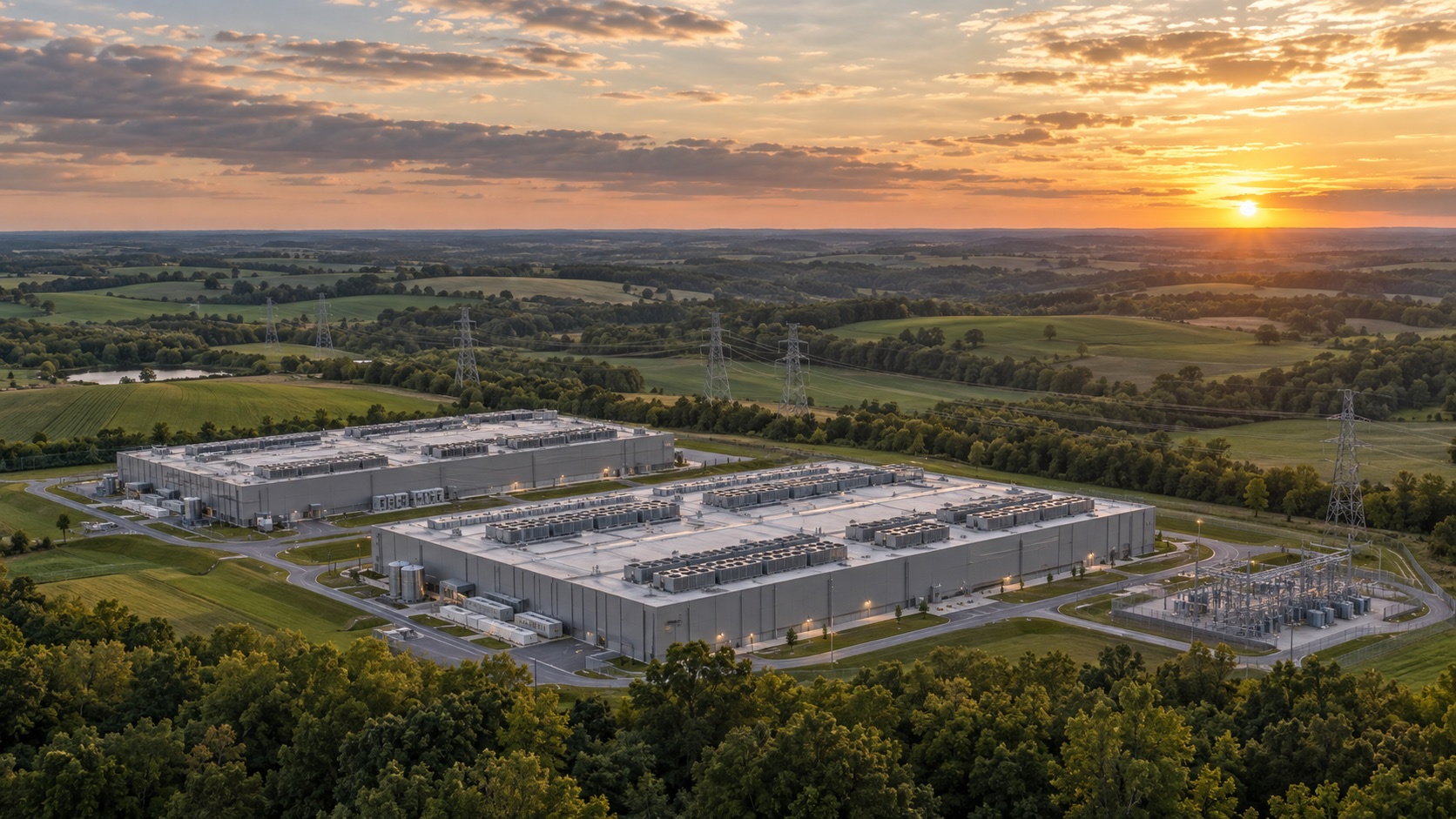
Data centers support the technology Missouri families and businesses use every day—from cloud services and communications to artificial intelligence.
As digital infrastructure expands, communities deserve clear information about the opportunities, infrastructure needs, and protections that responsible development requires.
Why here, why now
Missouri Is Emerging as a Central Digital Crossroad
Site selection for modern hyperscale and enterprise compute campuses is an exacting process of elimination. Missouri clears key geographical, logistical, and energy hurdles—though each proposed site requires independent verification of available utility headroom.
Central Continental Hub
Centrally located within the contiguous U.S., Missouri offers minimal round-trip network latency to Chicago, Dallas, Denver, and Atlanta.
Large Industrial Parcels
Designated technology parks like Golden Plains in Kansas City and legacy manufacturing brownfields provide shovel-ready contiguous acreage.
Grid & Transmission Paths
Major 345 kV and 500 kV transmission lines intersect across Evergy and Ameren Missouri territories, connecting to both MISO and SPP regional grids.
Transcontinental Fiber
Interstate 70 and railway easements carry primary transcontinental long-haul fiber routes with carrier-neutral interconnects in St. Louis and Kansas City.
Freight & Rail Corridors
I-70, I-44, I-55, and Class I railroad junctions facilitate the transport of ultra-heavy electrical transformers, switchgear, and modular data halls.
Skilled Industrial Trades
Missouri possesses deep mechanical, electrical (IBEW), and pipefitting labor union apprenticeship pipelines honed in aerospace and automotive manufacturing.
DED Certified Program
Missouri DED administers clear statutory sales tax exemptions for certified qualifying computing equipment with verified capital thresholds.
Dual Regional Markets
Anchored by two metropolitan economic engines—Kansas City and St. Louis—plus regional research clusters in Columbia, Rolla, and Springfield.
Missouri Data Center Tracker
Data Centers Across Missouri
A verified running record of announced projects, site evaluations, and operating campuses across the state. Entries cite public records, PSC utility dockets, and official state filings. Items not disclosed in public filings are explicitly labeled 'Not publicly disclosed'.
Meta Kansas City Data Center Campus
Meta's flagship multi-building cloud campus at Golden Plains Technology Park in Kansas City, Missouri. Operating since August 2025, supported by Missouri DED certified data center exemption.
- Location
- Kansas City, Clay / Platte Counties
- Operator / Sponsor
- Meta (Facebook)
- Investment
- $1.0+ Billion
- Power Capacity
- Not publicly disclosed (Served by Evergy large-load tariff)
- Cooling System Architecture
- Direct evaporative with dry cooling optimization; 100% renewable energy procurement matching
- Jobs (Announced)
- Approx. 1,400+ construction trades peak; ~100+ permanent operational roles
Straight answers
The Questions Missourians Are Asking
We do not route around the hard questions. Communities deserve candid answers on power bills, water use, noise, schools, and infrastructure costs before major projects break ground.
Will my electric bill go up?
Under Missouri PSC regulatory oversight, large loads must pay their own transmission and substation interconnections through specialized tariffs, protecting residential ratepayers.
How much water do data centers use?
Water consumption varies by 10x depending on cooling design. Missouri projects range from evaporative cooling to waterless closed-loop systems like Edged Energy's Kansas City campus.
How many jobs do they create?
Construction phases generate hundreds to thousands of union trade jobs over 2-5 years. Permanent operations jobs are leaner (30-150 staff) but offer high median compensation.
What do local schools receive?
Property tax and Chapter 100 PILOT agreements generate substantial local tax base, but net school impacts require district-by-district formula analysis under Missouri's foundation formula.
What about noise and the environment?
Chillers, rooftop cooling fans, and emergency backup diesel generators produce acoustic emissions that require perimeter setbacks, sound walls, and DNR air permits.
Who pays for new infrastructure?
The developer must fund dedicated transmission line extensions, dual-feed substations, and water trunk lines under Missouri utility service agreements.
What is closed-loop cooling?
Closed-loop cooling recirculates a fixed volume of coolant or refrigerant, rejecting heat to outdoor air with minimal ongoing water evaporation.
What about backup generators and emissions?
Facilities maintain on-site backup generators solely for grid emergency resilience, permitted under Missouri DNR air quality standards.
Ratepayer protection
Growth Should Pay Its Own Way.
The central tenet of responsible utility regulation is simple: residential families and existing small businesses must not be forced to subsidize the high-voltage infrastructure required by massive new computing campuses.
Under the Missouri Public Service Commission (PSC), utility ratemaking adheres to the "cost-causation" principle. When a large electrical customer requests tens or hundreds of megawatts, dedicated tariffs and special contract agreements mandate that the developer covers line construction, substation transformers, and long-term demand charges.
How cost responsibility should flow
Data Center Request
A very large computing facility requests 50 MW to 300+ MW of electric service from the utility.
Load & Grid Studies
RTO (SPP or MISO) and serving utility model transmission impacts and firm capacity needs.
Dedicated Infrastructure Built
Dedicated transmission lines, substation transformers, and protection relays are engineered.
Developer Pays All Direct Costs
Developer pays Contribution in Aid of Construction (CIAC), multi-year minimum demand charges, and letters of credit.
Water & technology
Not Every Data Center Is Built the Same.
Modern Cooling Architecture Shapes the Water Equation.
Cooling design—not building square footage—determines water consumption. Two facilities with identical physical sizes can differ by hundreds of millions of gallons annually depending on whether they deploy evaporative cooling towers or closed-loop air-cooled chillers.
In Missouri, facilities like Edged Energy's Kansas City campus demonstrate ultra-low water closed-loop systems, whereas other campuses may utilize evaporative chillers to conserve electricity during high summer temperatures.
Closed-Loop Cooling
Recirculates fixed fluid with negligible consumptive makeup water.
Air-Cooled Dry Chilling
Consumes virtually zero water by transferring heat directly to outdoor ambient air.
Direct-to-Chip Liquid Cooling
Coolant flows directly over microprocessors, ideal for high-density AI workloads.
Missouri DNR Water Oversight
The Missouri Department of Natural Resources (DNR) provides industrial water guidance, evaluating municipal water supply capacity, industrial wastewater discharge, and drought contingency planning.
Air cooling saves water but increases electrical draw.
Counties can mandate closed-loop cooling in approvals.
Our standard
What Does Responsible Data Center Development Look Like?
Missouri can compete for cutting-edge technology investment while demanding that it be done right. These are the principles every project should satisfy, and the checklist we apply to every filing in the state.
Ratepayer Protections
Existing Missouri households and small businesses must never bear the cost of electrical transmission, substation builds, or capacity additions required by data centers.
Transparent Communication
Developers must share clear, verifiable facts about power demand, water consumption, noise profiles, and tax structures early in the planning process.
Early Community Engagement
Town halls, public hearings, and candid dialogue with neighbors and school boards before zoning, permits, and tax abatements are finalized.
Environmental & Air Review
Full compliance with Missouri DNR regulations on backup generation emissions, stormwater runoff, and wetland protections.
Water Planning & Conservation
Commitment to waterless closed-loop or high-efficiency cooling architectures that preserve municipal reservoirs and aquifers.
Noise Mitigation & Setbacks
Acoustic baffles, engineered sound walls, and generous property buffers that maintain quiet residential neighborhood boundaries.
Local Hiring & Trade Partnerships
Priority hiring of Missouri union trades (IBEW, pipefitters, ironworkers) for construction and local apprenticeships for ongoing operations.
Long-Term Accountability
Enforceable development agreements with clear milestones, clawback provisions on tax incentives, and ongoing public reporting.
Community
Your Community. Your Questions.
Data center proposals involve hundreds of millions or billions of dollars, but communities deserve verified answers before decisions are made.
Have a question about a proposed site in your county? Want to know whether an interconnection filing has been made with the Missouri Public Service Commission? Contact our educational research team.
Direct Email Inquiry
We review public filings and provide factual explanations based on state and utility dockets.
info@missourifordatacenters.comSubmit an Inquiry
Inquiries are answered via our FAQ and educational briefings.
To contact the Missouri For Data Centers research desk regarding public utility dockets, DNR water assessments, or county land planning, email us directly: